

Using Physics history to examine impacts of AI
Something on generative-AI, GPT-4, Bard, LLaMa, etc, that is actually interesting

Enjoy the video 😀, some notes below it.
- Classical physics v modern (relativistic, quanta-driven, kinda unified) physics
- Why we should look at what physicists did in the face of new ideas.
- In relation to the "AI-invasion"
IMO there are two approaches to absorbing this new AI knowledge/ capability.
1. Find the AI operators to replace Classical operators
2. Start with a fresh sheet of paper
We could be inspired to think of…
James Maxwell’ famous equations, published in final form in his 1865 “A Dynamical Theory of the Electromagnetic Field” met the discovery of Special Relativity. Maxwell’s equations stacked-up.
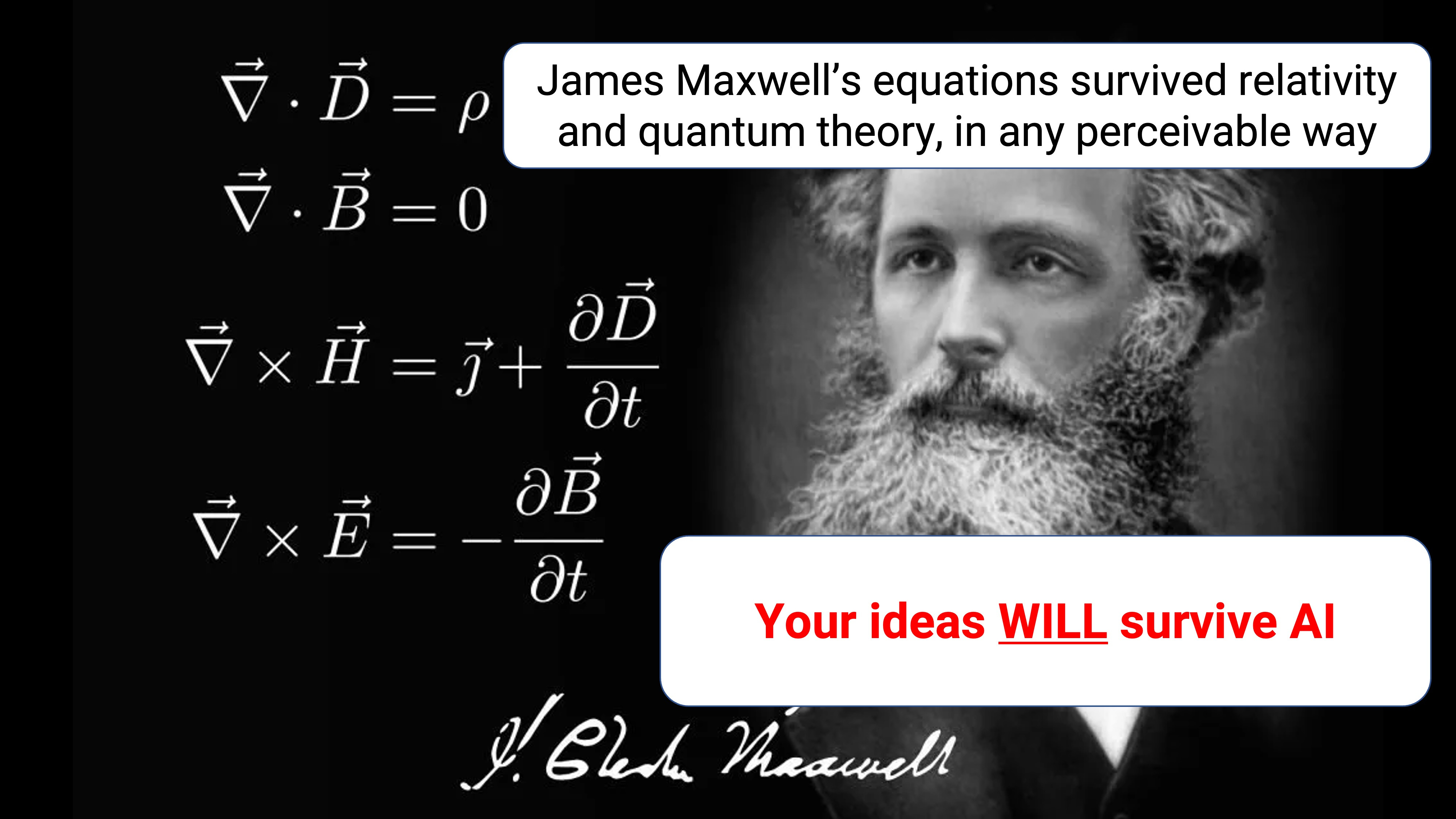
And then the continuous 20th century investigation of quantum theory that led to Quantum Electrodynamics (QED), the “fresh sheet of paper”.
With QED the entire framework of thinking, the mechanics behind Maxwell’s equations, completely changed. So in one sense “panic panic everything is destroyed!”.
However, in reality Maxwell’s equations still work perfectly, by which I mean 100% perfectly, in most situations. Electrical engineers solving the most hideously complex and intellectually challenging problems never need worry about QED.
I am confident that we will pick apart what all these new AI capabilities and what they change in a similar manner.
As per the video, I like so many others owe so much to my teachers. At University of Oxford, Wadham College, I was lucky enough to be taught by Dr Geoffrey Brooker and Dr C V Sukumar.
Dr Brooker has published this excellent book, Essays in Physics. It’s undergrad-level. So if you think you understand physics and want to go a little deeper, start here.